Pages

Showing posts with label fantasy. Show all posts

Sunday, January 22, 2012

Writing Simply

I once believed that life was a gift. I thought whatever I wanted I would someday possess. Is that greed, or only youth? 

Green Angel is one of my favorite books. You probably haven't heard of it. I bought it at my school's book fair in 6th or 7th grade, read it over the course of 4 hours, and still count it right up there with Dragonlance and Drizzt. I have a review of it over here in my webzine, if you're interested in a review, but for now, let's just go over what this thing actually is. 

Green Angel is a pretty short novel aimed at the roughly 13-year-old range. It takes place in an unspecified location in an unspecified time period with characters with really vague names. The main character is called Green, and she's practically a plant empath. She's good with gardening to the point that it's a borderline magic power. The plot follows her from a first-person view as she recovers from losing her family in some sort of disaster, also very vaguely described.

What makes the book so fantastic is the way it's all put together. Absolutely everything about the book gives it a sort of dream-like, surreal atmosphere. When dialogue is spoken, it's italicized rather than put in quotes. It sort of makes you wonder if anyone is really speaking at all, or if it's all imagined in some kind of dream. Everything has a dark, poetic simplicity to it, and I think it's beautiful. It's full of things that hit me really hard just because of how simply they were put. No dramatic death scenes. No epic battles. Just simplicity at its finest. 

It's a kind of writing that's impossible to emulate by trying. It has to naturally flow, or you're going to break that simplicity. I've read through a lot of reviews of Green Angel, and it seems that the style is either loved or hated. It's too different to be somewhere in between. You can either appreciate the magical surrealism of it, or think it's the dumbest thing ever and go for something more realistic. Personally, I think it's one of the best ways to write a story, and whenever I find something similar, I love it.

I had similar feelings towards I Am Legend, though to a lesser extent. Some lines are so hugely important, and yet they're also super simple and blunt. There's nothing to say other than the simple truth. I think those lines can sometimes make more of an impact than several paragraphs explaining a heroic death.

Like everything in writing (and everything, really), there are times and places for everything. Simplicity doesn't always work. Still, I think Green Angel really did it right.

Wednesday, November 30, 2011

Looking Back on NaNoWriMo

Today is the last day of the month, and my 15,740 words certainly won't get me a winner's certificate. I've essentially given up, and that's for a lot of different reasons, actually.

First of all, the past month has sort of been a wreck. October 30's car accident led to back pain for a week or so. I started my job at Target on the 4th, and they've been giving me LOTS of hours. I also got sick, which totally knocked me out for a few days, and then I had a bad reaction to NyQuil (which I took for the aforementioned cold) that put me in the hospital for tons of tests I can't afford. Feeling your heart beat 3-4 times per second is worth getting checked out, though, I guess.

The Devil's Blade was also not the novel I was going to write. I was planning a romance set in the 1970's with a farm boy and a kinda-sorta hippie girl. My back-up plan was to write a prequel to Among the People Lost that follows Solstice and Blaze in their time before Dante meets them. Then, on the day I started writing, I remembered this story. I remembered that I started to rewrite it and never really did anything with it, and I decided to give it a go.

Honestly, it started off okay. I realized pretty quickly, though, that NaNo just doesn't cater to my writing style. I don't like doing drafts. I like putting tons of time and thought into every sentence, making the story as good as I can on my first try, then going through after a few months of a break and looking for areas to improve. This whole write-tons-and-fix-it-later thing is just not for me.

I'm not someone who can let things go until later, either. I confuse myself if I put off research and make up a filler detail. I'd rather take the time to do my research and figure out what I'm doing beforehand.

I feel like my character development is severely lacking. That's something that I need to really sit down and figure out, because right now, it's going nowhere. Valdius is interesting, but not really interesting. Anastera, my main female, has about as much dimension as a sheet of paper. She has a history and abilities, but minimal personality. I never know how to write her dialogue. The best character I have right now is my imp Zirk. He's totally okay and needs, like, no work. It's really pathetic that that's how things progressed.

For now, I'm shelving the story for a few months so I can look back on it with a fresh mind. In the mean time, I'll finish off my Among the People Lost prequel I started that follows Dante and Hunter. I put it on hold for NaNo, and now that I've taken a break from it, I'm ready to get back into it and pump out the rest of it.

I'll keep posting writing tips periodically. I have quite a few more that I think will be fun to share. I'm hoping I can more or less return to the internet now that I'm over my cold. It's been a rough month. 

Tuesday, November 29, 2011

Writing Tip #10

I'm blogging when I should be working on my webzine and/or sleeping for work later. Oh well. Let's get right to the point here.

Tip #10: Humanize your monsters.

I'm doing something interesting in The Devil's Blade - I'm making the Grim Reaper, who is often portrayed as a skeleton, someone who was once an ordinary human and who, aside from being deathly pale, looks like an ordinary human.

A lot of stories take the Beauty and the Beast approach, arguing that it takes a really good-hearted character to fall in love with a monster. I'm blatantly ignoring that. It's not that I think it's a bad concept; I just think that we tend to see monsters as these scary things because we fear them, when maybe, if we looked just a little closer, we'd find they aren't that scary at all.

Valdius keeps his face hidden until a few chapters into the book. He's shrouded in mystery, and people are generally very afraid of him. It's much more terrifying to see a hooded figure with a scythe than it is to see some random pale guy with a scythe. When he finally chooses to reveal his face, it's a very important moment for his character. It shows that there is someone he likes enough to be human with, rather than the monstrous facade he keeps up.

Similarly, I have an imp character Zirk who is a friend to Valdius. Despite being a demon, he's essentially a good character. While certainly not human in appearance, he's not scary, either. Valdius himself perhaps describes him the best:

He looks like a carved gargoyle and only comes to my knees. He has little horns and red eyes, but he's not very intimidating. 

I know a lot of people, myself included, that would even go as far as to think he was sort of cute, in that cute-little-gargoyle sort of way. He needs to be a likeable character. Making him some kind of horrifying monster would push a reader away from him and make him lose that cute factor. As it is, he's relatively easy to picture, and also looks pretty small and harmless. He doesn't come across as being evil just by his appearance.

Of course, like all things in writing, humanizing your demons (literal demons, in this case) won't always work, but for this story, I think it's the way to go. 

Saturday, November 26, 2011

Writing Tip #9

My NaNo novel is not even close to being complete. It's at 15,000 words and falling to bits. Mainly, I keep hitting this major issue of trying to decide what the hell I'm going for. On one hand, it's a fantasy. It has demons, spirits, and general supernatural stuff like demonic powers. On the other hand, however, most of that isn't 100% fictional. A lot of it has roots in mythology, religious texts, and the general knowledge (whether or not you believe in it is another thing) of how we understand demons, ghosts, energy, and death.

Unfortunately, it also has a huge amount of influence by Catholicism. I say "unfortunately" because religion is always touchy. I'm well aware that very few people will be able to look at this story the way I intend it, and the last think I'm trying to get my readers to do is go fall in love with someone who signed their soul over to the devil. It's intended to be a story about sacrifice and redemption, not devil worship and murder.

The biggest problem is that my story is set tentatively in the 1400s or so in an alternate, more fantasy-like England. This brings me (finally) to my next writing tip.

Tip #9: Accuracy Versus Perceived Accuracy

One of the things I really prided myself on when writing Among the People Lost was my attention to detail and keeping things very accurate. I used a car at one point that had front-wheel drive, so I researched what cars are front-wheel drive. I know most people wouldn't catch the details like that, but for the car people who read that, they'll think it's impressive that I was right.

Naturally, since The Devil's Blade takes place in a 1400s setting, I did research on the middle ages to be as accurate as possible. I then realized that I was screwed.

When you think of chivalry and medieval romance, you probably think of something like knights wooing the local women with flowers and kisses on the hand and such. That would have been doable. What I learned, though, is that the romantic kiss-on-the-hand came 200-300 years later, and no one gave flowers. Instead, it was all love letters, singing, and poetry. I think the Grim Reaper would lose at least half of his badass points if he regularly burst into a romantic song or poem. 

Clothing is also an issue. You certainly don't think of a reaper running around in tights, pointy shoes, and a doublet, or the female love interest of the story wearing an unattractive, shapeless gown sort of thing and covering her head.

It's becoming more and more obvious as I write this that I can't have a halfway decent romance novel if I don't break away from medieval accuracy and aim for a more medieval fantasy setting. Most people are going to think a kiss on the hand is totally time-period appropriate anyway, so why not use it? Boots existed. They may not have been common, but who cares? Let's put the reaper in boots. So what if no one gave flowers? Let him give her a rose, dew frozen on the petals by the cold that emanates from his unearthly body.

There's this big gap between how the middle ages actually were and how we tend to think of them. The truth is, medieval romance is outdated. It's not even what we would consider "romantic" anymore, in a lot of cases. Beyond that, most marriages were arranged until the 1600s. This story wouldn't even be happening.

Some things need to stay the same regardless, though. Premarital sex (which there is admittedly a lot of in Among the People Lost) is pretty much out of the question, especially given that both main characters are religious. Jewelry and women's rights are minimal at best. My lead female won't be going around doing any fighting like Solstice does in Among the People Lost. Religion plays a big part in every day life; this is when Catholicism really got big, and that can't really change.

I've really just hit this point where I have to abandon a lot of accuracy to get the effect I want to get. It goes against everything I taught myself to do when writing science fiction, but fantasy is not science fiction. There's much more room to modernize and adapt, and sometimes, that's what you need to do. 

Thursday, November 17, 2011

Writing Tip #7

Whee, my first cold since I started working at Target! I knew I would get one sooner or later. Going from next to no human interaction to a job where I do 50 transactions an hour is bound to wreck my immune system. Anyway, it wasn't a bad one, and it's mostly gone already. I'm still really behind on my NaNo novel, and being asleep for a day didn't help any.

One thing I've noticed with this novel is how few characters I'm working with. I have Valdius, the Grim Reaper, and an imp named Zirk who is almost always with him. Anastera is the lead female role, for movie terms, and I don't talk about her on her own much, either. I also have the ghost of a priest and Valdius' horse, but they aren't ever talked about on their own. The focus is always on either Valdius, Anastera, or Zirk. This made me think of something else my story is lacking that may be hindering my progress.

Tip #7: Put yourself or a close friend into your story.

I think of every character I write as an extension of my personality. Every character has a trait or two that stand out - Dante's bluntness, Solstice's sarcasm, Hunter's relaxed attitude. Each trait is a shred of our own personalities that we build upon and grow into a character who is centralized around that trait. Valdius repeatedly shows the sacrifices he is willing to make to protect the people he cares about. Zirk shows an almost human level of compassion beneath an exterior of mischief and sarcasm. Anastera...I don't know what the hell to say about Anastera. I haven't put much thought into her yet.

Point is, I see myself in every character I write, at least a tiny bit. Even if I write a character I despise and want to kill off at every opportunity, there is some small fragment of me - perhaps a flaw - in that character. It makes them relatable.

Dante was based off my boyfriend Tim, in both appearance and personality. Tim cares a lot for the people close to him and wouldn't mind putting himself in danger to protect them. Whether or not he'd arrive on time is another thing, but I digress. Those are a couple minor aspects of Tim that made their way into Dante. Other parts of Dante, such as his bluntness and artistic talents, are aspects of myself.

It's very easy to write a character when you feel like you really know them. It makes their dialogue and actions come very naturally. I know how my close friends will react to certain things. They all have their little things that they say all the time, their favorite words and phrases, and their fidgety habits. I pick at my lip when I'm in deep thought. Tim sort of furrows his brow, puts his hand on his chin, and tilts his head like he's trying really hard. He usually is, actually. 

Sometimes, we write characters and think, "Wow. This character is really similar to Steve, now that I think about it!" That should be a good thing! If you know Steve well, you'll know how that character, who is some fictional reincarnation of your real life friend, will act. It makes everything flow.

In The Devil's Blade, I don't really feel like I know any of my characters, and it's constantly slowing me down. I keep thinking, "Would he do this? How would she feel after all of that?" and it's wrecking my progress. It would be much easier if I had just modeled my characters a little more after people I know.

Sunday, November 6, 2011

Writing Tip #4

Skipped a day because of work, but let's get one of these down before I fall super behind! Also, I realize that so far, these are more "Character Development Tips" than "Writing Tips," but I'll get to more general things later. As I've said in the past, character development is the most important part to me. For those of you doing NaNoWriMo, good luck getting to 50,000 words if your characters all lack depth.

For this example, I'll be using two characters who have very little in common. I've used Dante in several other examples, so I'll use him here as well. He's straight-forward, quick-witted, and very sensitive to the needs of those around him. The next character is Valdius, the main character in my NaNo novel. Valdius is the Grim Reaper. He's trapped, alone, and detached. Both characters are highly skilled in certain areas and completely hopeless in others.

Tip #4: Use the 7 Deadly Sins to Create Conflict

Most things we humans consider bad or sinful can be labeled as one of the infamous 7 Deadly Sins. For writers, they make some good springboards. Think of how each would impact your character, if at all. It's a good way to see your character's strengths and weaknesses, and also see if they're well-balanced. Characters who have no weaknesses aren't particularly interesting, and neither are characters who are weak to everything in existence.

Wrath
Dante is pretty good at controlling his anger. Losing control would put him in a very bad position in most cases. Piss off Valdius, however, and you can be prepared to face an army of demons. Dante goes about revenge in a very cautious, opportunistic manner to ensure his success without putting too much at stake. Valdius will kill anyone who gets in his way, regardless of how much danger he is in.

Lust
Dante rarely - if ever - makes the first move in a relationship. This is an area in which he is very shy and very respectful of the other person involved. Valdius will go out of his way to protect a woman he barely knows, even while it is very unlikely they would ever be together. He is also not afraid to break a few dozen rules and guidelines while pursuing that woman.

Envy
Dante has very little interest in the possessions and skills of others. Valdius would give anything to be human.

Greed
Both Dante and Valdius live in situations where possessions and wealth are meaningless. Both have the potential to amass followers, but neither is interested in power, either.

Gluttony
Dante overindulges in alcohol to remove his stress. It doesn't matter to him how much he takes into his system, as long as it helps him sleep at night. Valdius has no physical need for food and drink. There is also nothing he does simply for the joy of doing it in excess.

Pride
Dante is very confident in his abilities, but not to a fault. He knows when he will be outmatched and when he lacks the necessary skills. Valdius knows he means nothing to his master, and he is well aware that he will be punished if he is caught breaking rules.

Sloth
Neither Dante nor Valdius is lazy. Both are extremely motivated to keep busy, Dante because of his friends, and Valdius because of the fear of punishment.

So there. Applying these things to your own characters can help outline their ideals and motivations and such. Happy sinning!

Thursday, November 3, 2011

Writing Tip #3

I think I'll try to make these daily, since I'm on the 3rd and it's the 3rd. :P

Tip #3: Think of your character in the wrong setting.

Adaptability is one of the best things about humans. We're able to adjust to a different environment when necessary to stay alive. Think of how your wizard would react to suddenly appearing in 2011. Would he try to blend in? Maybe the sensory overload would be too much and he'd go insane. How characters react to drastic changes says a lot about their personalities, their willpower, and their survival instincts.

In most cases, I believe it would be easier on a character to go backwards in time. We all know how people dressed in the middle ages, and we could blend in appropriately if sent back in time. If your character is fighting and killing in a modern war, he would probably find a way to do the same thing if we put him back in the Roman empire.

I think it's interesting to think about how we and our characters would take on a role in a world completely new to us. What would you do if you arrived in a world that required your concentration to learn how to cast spells? What class would you take on in a D&D universe? I think that, in any world, we are drawn to the things we feel suit us. A doctor in this world might go for a WWII medic or a magical healer, depending on the setting we throw him into.

It says a lot about your character when you can look at a setting and say, "If my story were this kind of story, he would be that, without a doubt." 

Friday, October 21, 2011

My Top 10 Drow

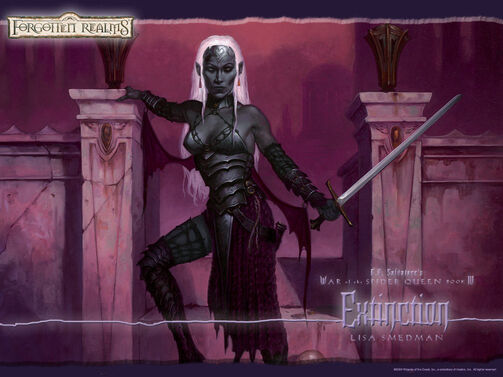
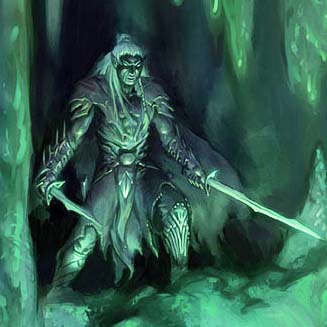
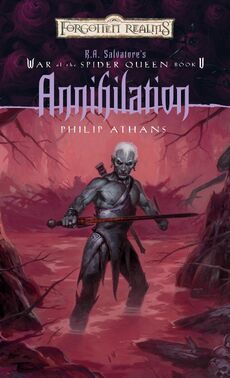
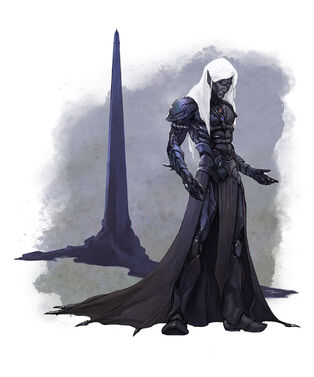
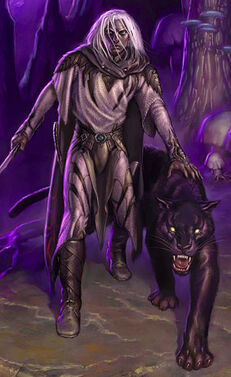
I love drow. I love the Forgotten Realms world in general, but mostly, I love drow. The black-skinned, white-haired, spider-worshipping dark elves that live in caves untouched by the sun are pretty much the best sort of elf to ever exist in the pages of fantasy. There are a few spoilers in here, so if you haven't read The Legend of Drizzt or War of the Spider Queen books but plan on doing so, maybe skip the ones you aren't familiar with.


10. Vierna Do'Urden 
Vierna is a rare drow. As a priestess, she is expected to be horrible and evil; sometimes, however, a little bit of her calmer, nicer inner self shows through, and she's not such a bad person after all. Then she goes crazy and turns her brother into a drider, and you can forget about her being nice ever again.

9. Quenthel Baenre
A high priestess of the Spider Queen, Quenthel is very dedicated. She is completely dispassionate towards her fellow drow, and maintains her faith through very difficult trials. 


8. Lord Dyrr
Dyrr is a lich. He's amazingly powerful and wants even more power all the time. He doesn't care at all who gets in his way.


7. Halisstra Melarn 
Halisstra is a high priestess of the Spider Queen until she converts to a freer, more peaceful religion followed by a group of drow living on the surface. She changes her evil ways completely to live a life of dancing under the moon, and she even falls in love. I was legitimately very angry with her when she later abandons that life to go back to the Spider Queen. It ruined my life.

6. Zaknafein Do'Urden
I really liked Zaknafein's presence in the Legend of Drizzt series. He is a father figure, a master trainer, and a friend, yet the empathy he clearly possesses has been suppressed due to the violent and evil he lives in. He is a good-hearted character who lives a miserable existence to survive, and he does his best to make sure Drizzt doesn't succumb to the evil ways of the drow. Even when manipulated by powerful magic, he refuses to kill his son, and destroys himself instead.

5. Ryld Argith 
Ryld is a weapons master who isn't a particularly interesting character until he abandons his life in Menzoberranzan to settle down in peace and love on the surface. His empathy is unusual for a drow, and it is even more unusual that he acted upon those emotions and gave up his old lifestyle simply for love. Even when betrayed, he has no regrets. 

4. Jarlaxle 
The leader of a band of rogues, Jarlaxle is one of the most influential male drow in Menzoberranzan. His presence is tolerated and even approved by the Spider Queen herself. He has a wide array of magical items that give him a huge assortment of abilities. He never runs out of tricks, and often uses illusions to his advantage. He's eccentric, brilliant, and highly resourceful. 

3. Gromph Baenre
The archmage of the largest drow city, Menzoberranzan, is Gromph. He's got tons of power, tons of influence (especially for a male drow), and tons of crazy secrets. He fights Lord Dyrr at some point, and the battle is stretched over two books (probably about 8 chapters in total) just because they kept outdoing each other. Gromph has a typical lack of compassion and a total disregard for anyone who gets in his way. 

2. Drizzt Do'Urden
If you know drow, you likely know of Drizzt. The Legend of Drizzt series contains some of my favorite books to date. Drizzt breaks the stereotypical evil of his race and lives as a ranger on the surface, beneath the sun and with the dwarves and humans in the cold north. His constant struggles to escape his past and his unmatched swordsmanship skills make his adventures quite interesting and dynamic. He forms very strong bonds with his friends, and their safety is always his top priority. I love the mentality he maintains throughout the series, as he talks about the importance of sticking to your beliefs and such.

1. Pharaun Mizzrym
Pharaun is significantly awesome. He's a very skilled wizard who doesn't care a whole lot about the Spider Queen. He likes keeping his appearance tidy and neat, and he's often complaining about getting dirty. He's very drow-like in his egocentric mindset; he will eliminate whomever he has to in order to secure a better position for himself or keep himself alive longer. One of my favorite things about him as a character is his dialogue. He's always going on - in a very formal way - about the intricacies of everything, carefully examining every slight flavor in his wine and dwelling on the characteristics of everyone he meets. Pharaun is also good at talking himself out of bad situations (probably to avoid messing up his hair), and he'll try whenever he can. He once asked a very large demon, "Will you consent to parlay?"


Wednesday, October 12, 2011

Daily Art - Magic Fish

I'm running really low on artwork to post. XD This was drawn for a friend when I took quick requests over Facebook. It was the only request I got that wasn't ridiculously difficult. lolpeople.

Wednesday, October 5, 2011

How to Write a Book

As someone who's actually taken the time to finish a whole novel, I can say that there are quite a few things you have to take into account when you set up a story. When I wrote Among the People Lost, I tried my hardest to make my characters, setting, plot, and everything else very accurate and believable. I didn't do anything without having a reason (or reasons) for making things that way.

I'm reading a book right now that is the epitome of terrible writing, in my opinion. The lead character has no depth, the world seems conflicting and poorly designed, and the plot is, well, stupid. It makes me wonder how other people get so far as to finish a book without taking some really important things into consideration.

This is a list of important story elements. The top item is what I consider most important, working down to the least important. Note that all are of importance, and having great characters doesn't mean you should ruin your plot. The list will vary depending on who you ask, of course.
-Character development
-Main plot
-Feel of the setting (empty, bustling, scary, dangerous, etc)
-Physical setting (city appearance, buildings, locations)
-Time period
-World "rules" (how society perceives certain behaviors, laws, what is necessary for survival)

Character Development
While a lot of aspiring writers pursue courses for creative writing and journalism, I took an interest in psychology. My knowledge of mental disorders, social interactions, attraction, and general human behavior has played a big part in developing my characters to be very realistic. I don't like making characters who don't seem real, and it doesn't matter to me if their actions end up being a little predictable because of it. Realism is my priority. I even take great lengths to develop appearances and such, as explained in part 1 of my OCD series (Original Character Development), which shares its name with Obsessive Compulsive Disorder because I've joked in the past that you need the disorder to possibly put as much thought into characters as I do. 

Main Plot 
The main story you're working with needs to be interesting, plausible, and thought out. Admittedly, I wrote Among the People Lost with no idea where it was going. Lesson learned. It made it difficult to write at times, and when I looked back, I found a lot of places where not much was happening. There was also a character that I tried to kill off about a dozen times, but it always seemed really out of character, so I let her stay. She survives the book and the sequel.

Feel of the Setting
Among the People Lost is set in a sort of post apocalyptic world. I wanted to create a feeling that reflected the survival-of-the-fittest lifestyle the characters lived. Things are grungy, lots of buildings are abandoned, fresh food is a luxury, and everyone is always on guard. No one uses their real name for fear of being hunted by gangs, and they hunt the gangs themselves to keep others safe. It's this really brutal, dirty setting.

Physical Setting
I was working with a city I know, Scranton, PA. I know that there are a lot of brick buildings, and even though I used almost no real buildings as references, it still feels like you're reading about Scranton. I feel research is important if you're using a setting you don't know in real life, and if it's a fictional city, I think it's important to decide how the occupants live.

Time Period
Time periods will affect your world's technology, the common mindsets, and even popular names. It affects everything in ways, so it's important. With my book, set in 2026, I had quite a bit of leeway to work with. It all depends.

World Rules
If magic exists, it's important to know its limitations, costs, and management. Does it work by praying to the world's gods, or by manipulating nature? Does it make the caster exhausted? Are there laws against excessive magic use? There's certainly no magic in my book, but different rules apply than they do in real life. Killing is necessary to survive, and no government exists to regulate the violence and drug trade that has no become a way of life. The world is essentially in anarchy. Morals have shifted from "defense of yourself" to "defense of all innocent people," and hunting down the gangs is the right thing to do. Every setting is unique, and it's up to the writer to set rules that work for each world. Having things that contradict those rules, such as an airplane in a sword-and-spell fantasy, make it hard for the reader to suspend disbelief. The book I'm reading now has werewolves with air ships. There's no evidence that the werewolves have powerful magic (or any magic at all), and technology in the world is far from producing air ships. It just seems really dumb and out of place.

Saturday, October 1, 2011

Daily Art - Silvara

Some Dragonlance fan art. :D

Friday, September 30, 2011

Daily Art - Bug Demon Skull

I just wanted to practice some bone coloring.

Thursday, September 22, 2011

Daily Art - "Fairy Fire"

You D&D fans should know what fairy fire is. :) For those of you unfamiliar with the ways of magic, fairy fire is a spell (used often by drow in plenty of Forgotten Realms books) that outlines the target in harmless purple flames.

Saturday, September 17, 2011

Daily Art - Princess Stella

In honor of season 2 of My Little Pony: Friendship is Magic starting today, here's some pony art. This was for a contest on DeviantART to design a prince's father. Princess Stella raises the stars at night.

Wednesday, July 27, 2011

8 Things I Want But Can Never Have

I love stuff. Like, seriously. Stuff is the best stuff ever. You know what the best kind of stuff is? The stuff that doesn't exist!

A Teleporter
Bonus points if it can teleport me through time.

Some Vampire Fangs
I don't mean I want fangs. I mean I want someone else's venom-covered fangs so I can join the eternal undead. In all seriousness, I would probably go for the Twilight-type vampires. No sleeping, no eating, and I don't mind sparkling a little. All I'd really have to do is drain a cow every now and then, and I'm set! But that's a pretty big decision. Until I decide that's really what I want...

A Philosipher's Stone
So I can try out the imortality thing without drinking lots of blood!

A Timeturner
A tiny device to manupulate time would likely be the most practical item on this list.
Whee!


A Fort
A big one, with towers and spires and battlements and bridges, and a massive underground network of dungeons and tunnels!

Room of Requirement
Put it in the basement of my fort, please. It would provide me with access to any stuff I may want or need.

A Dragon
I don't think I'm really picky here. I just want a dragon. So long as it's a nice big dragon with wings and the ability to talk, I'm cool with that. Though I imagine dragons are very high maintenance.
Like Kyle!


A Holodeck
How freaking wonderful would it be to have this room that you can program to look like any place you want, with characters that interact with you fully? Think of how it would change your gaming experience. Want to go play Morrowind for a little while? Put on your armor and get in there! Also, the fictional worlds I could create and explore. Here I come, Underdark! This can hang out in my fort right near my Room of Requirement. That way I can go into the room and conjure up whatever I need for my Holodeck experiences, then spend the rest of my life next door in some fictional world.

England on a whim? Yes, please.


Friday, June 10, 2011

Thursday, November 18, 2010

Daily Art - "Crenshinibon"

Named after the Crystal Shard, Crenshinibon, that appears in several books through the Legend of Drizzt series by R. A. Salvatore. :)

Friday, January 8, 2010

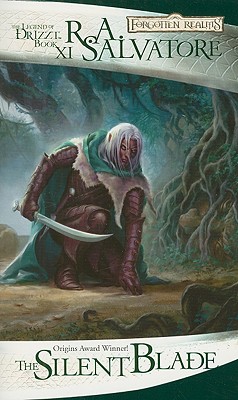
The Silent Blade


I am a huge fan of The Legend of Drizzt series by R. A. Salvatore. I've read Homeland through Passage to Dawn and loved every page of every book. The Silent Blade didn't disappont, of course.

My first taste of the Forgotten Realms world was the series War of the Spider Queen, in which a group of drow elves traverse their underground cities, the surface, and ultimately the Abyss to find their godess Lolth, the spider queen, who has become silent. It was tough to get into because each book is by a different author, but it really picked up and I loved it in the end.

I wasn't sure what to expect from my first Drizzt book, Homeland. It was really easy to fall into. The detail of battle scenes and the depths of emotions were incredible. Segments written from Drizzt's point of view that separated the book into three or four parts were so insightful and thought out, it was hard to believe that I was reading fiction and not listening to a dark elf standing next to me.

I'll keep reading about Drizzt Do'Urden and his companions as long as books are written. If you haven't read them, they're a must for any fantasy fan, and great for their philosophical and psychological intrigue if you're not.